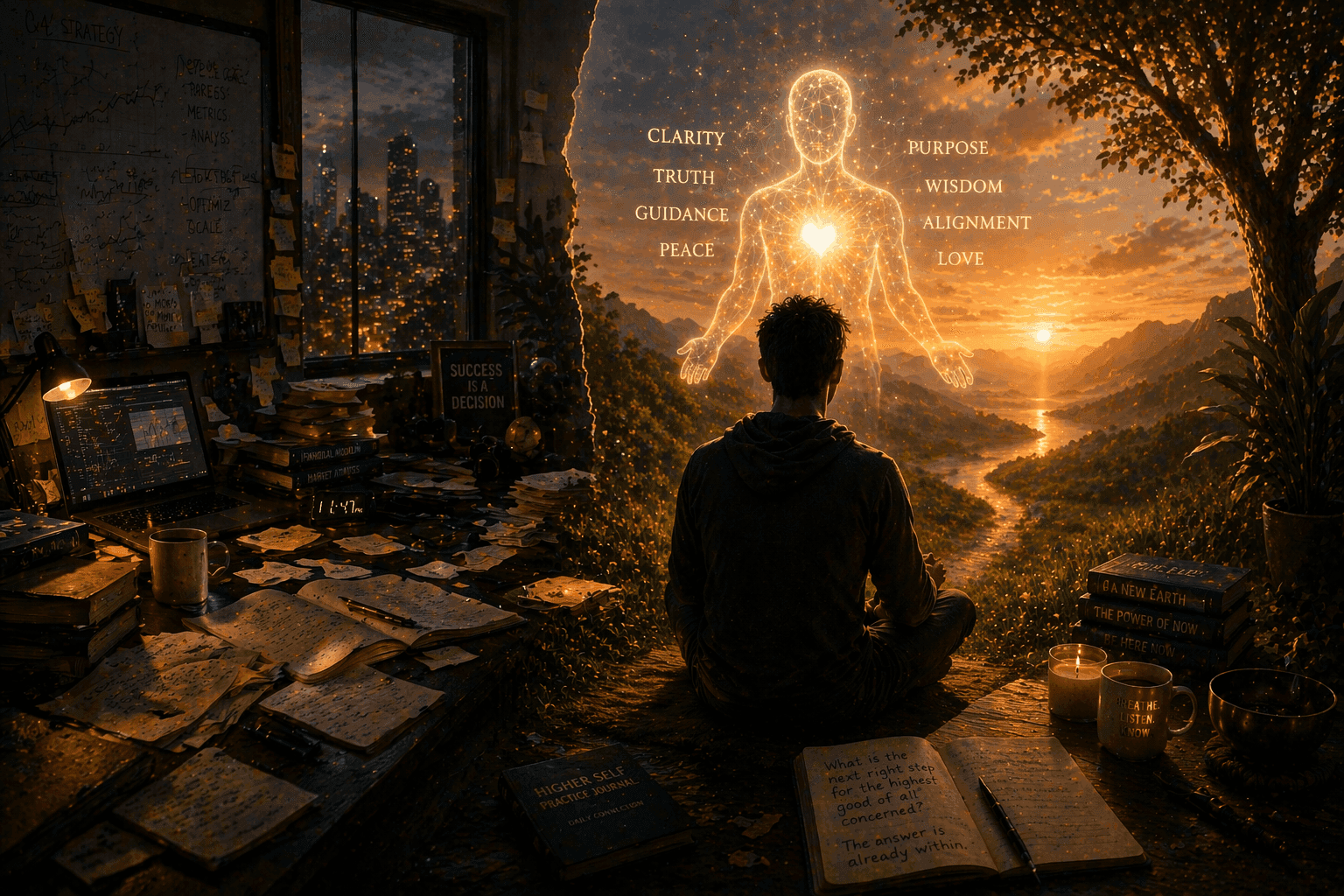
What Is Your Higher Self? And Why Ignoring It Is Costing You
There is a part of you that already knows.
Not your brain. Not your logic. Not the version of you that makes spreadsheets and career plans and convincing arguments for why you are fine.
Something deeper. Something quieter. Something that has been trying to get your attention for years — and that you have, in all likelihood, been very good at ignoring.
That is your Higher Self. And what it costs you to keep tuning it out is more than most people realise.
The concept that stopped me cold
I was not someone who used phrases like "Higher Self." I was an engineer. I thought in systems, logic, and measurable outcomes. Spiritual language made me uncomfortable — it sounded unverifiable. Soft. Like something people said when they didn't have real answers.
But I had also tried everything the logical mind had to offer. I had chased success, status, stimulation. I had built a life that looked right on paper. And underneath all of it, I felt profoundly disconnected.
So when I came across the work of Maureen J. St. Germain and the practice of connecting with the Higher Self, I didn't embrace it immediately. I held it at arm's length and watched it.
And then something shifted. Quietly. Clearly. In a way I couldn't explain and couldn't dismiss.
That shift is what I want to talk about here.
So what actually is the Higher Self?
The Higher Self is not a metaphor. It is not a mood, or an aspiration, or a peak state you access at a retreat and then lose on the drive home.
It is a part of you — a real, accessible, consistent part — that exists beyond the conditioning of your upbringing, beyond your ego's need for approval and safety, beyond the story you have been telling about who you are and what you are allowed to want.
Think of it this way. You have a mind that thinks. It generates ideas, analyses situations, makes plans. It is extraordinarily useful. But it is also limited — by what you already know, by your fears, by the patterns laid down in childhood, by everything you were taught to believe about yourself and the world.
The Higher Self does not think. It knows. And the difference between those two things — between the mind generating an answer and something deeper simply having it — is something you can only understand by experiencing it directly.
It is quieter than thought. Slower than instinct. More consistent than intuition as most people use that word. And it is, in my experience, more accurate than anything the rational mind has ever produced on its own.
The pull you've been explaining away
You have felt it. I am certain of that.
It is the moment in the middle of a life that looks fine — the job, the relationship, the routine — when something in you goes quiet and says: this isn't it.
Not dramatically. Not as a crisis. Just as a quiet knowing that lands before your brain has time to argue with it.
Most people explain it away. They call it anxiety, or restlessness, or the unrealistic expectations of someone who has read too many self-help books. They get busier. They add more noise. They scroll a little longer and wait for the feeling to pass.
It always comes back.
For years, I did exactly this. I numbed it with stimulation — substances, screens, constant movement. I called it living. But underneath all of it, that presence was still there. Still. Patient. Waiting for me to get quiet enough to hear it.
That pull was my Higher Self. It was not punishing me for ignoring it. It was simply never going to stop.
What it actually costs you to keep ignoring it
When you are disconnected from your Higher Self, you make decisions from your conditioning. From your fears. From what you were told you were supposed to want, or what seems logical, or what will keep other people comfortable.
Those decisions tend to produce a particular kind of life. One that makes sense from the outside. One that other people can understand and approve of. One that leaves you lying awake at three in the morning with a persistent feeling that something is off, but no clear way to name it.
I know that life. I lived it. And the cost, over time, is not just dissatisfaction. It is the slow erosion of trust in yourself. Because every time you override that quiet knowing — every time you talk yourself out of what you actually feel — you teach yourself that your inner compass cannot be trusted.
And once you lose trust in your own compass, you become dependent on external ones. On other people's opinions, on social proof, on credentials and validation and the approval of people who do not actually know what is right for you.
That dependency is expensive. In ways that have nothing to do with money.
What reconnecting actually looks like
The good news is that your Higher Self has not gone anywhere. It cannot. It is not something you lose — it is something you become disconnected from. And that disconnection can be undone.
In my own life, reconnection began with meditation — specifically Vipassana, a ten-day silent retreat that did not enlighten me so much as strip away enough noise that I could finally hear what was underneath it.
After years of practice, I eventually found a specific protocol for communicating directly with the Higher Self — a method of asking questions and receiving answers through felt sensation rather than thought. Not mystical. Not vague. Repeatable. Learnable. Grounded in consistent daily practice.
It took me two years to build a connection I could fully trust. And then another year before it became what it is now — a daily conversation, a compass I consult before every significant decision, a presence I would describe as the most reliable relationship in my life.
That is not hyperbole. It is just what happens when you stop ignoring the part of yourself that actually knows what it is doing.
Why this matters — especially now
We live in a world that is extraordinarily good at keeping you in your head. The noise is constant. The inputs are relentless. And the pressure to have it figured out — to know your purpose, to optimise your productivity, to become a better version of yourself — has never been louder.
None of that noise comes from your Higher Self.
Your Higher Self does not rush you. It does not compare you to other people. It does not tell you that you are behind, or broken, or that you should be further along by now.
It simply knows. And when you learn to access that knowing — consistently, reliably, in the middle of ordinary life — the decisions that used to feel overwhelming become clear. The path that used to feel like something you had to figure out becomes something you can feel.
That is not a small thing. For most people, that is everything.
You already know this
Here is what I want to leave you with.
You have been aware of this part of yourself for longer than you think. The moments when you just knew something, without being able to explain why. The times you ignored that knowing and regretted it. The quiet pull that keeps surfacing no matter how much noise you pile on top of it.
That is not coincidence. That is not anxiety. That is not some vague spiritual concept that doesn't apply to someone like you.
That is your Higher Self. It has been here the whole time. And it is not going anywhere.
The only question is how much longer you want to keep ignoring it.
In the next blog, I'll walk you through exactly how I began communicating with mine — starting with the simplest possible question you can ask.
Written by
Abhinayan M. Kugendnan
Other Artilces