Higher Self Communication: How to Start With Simple Yes or No Questions
Before I could trust my Higher Self with the big decisions — the ones about where to live, what to build, who to become — I had to learn to hear it on the small ones.
What to eat for lunch. Whether to take a walk. Which shirt to wear.
It sounds almost embarrassingly simple. And that is exactly the point.
Why most people start wrong
When people first hear about communicating with the Higher Self, the instinct is to go straight for the meaningful questions. Should I leave my job? Is this relationship right for me? What is my purpose?
I understand that impulse. Those are the questions that keep you up at night. Those are the ones you actually want answered.
But starting there is one of the fastest ways to lose confidence in the whole process.
Here is why. The big questions carry enormous emotional charge. You already have strong opinions about them. Your fears are entangled with them. Your ego has a preferred outcome. So when an answer comes — or seems to come — you cannot tell whether you are hearing your Higher Self or hearing the loudest part of your own mind.
You second-guess yourself. The signal gets muddied. You conclude that the whole thing doesn't work for you, and you walk away from something that could have changed your life. Understanding how to tell the difference between ego and Higher Self is a skill that has to be built — and it is much harder to build when the stakes are high.
The solution is to begin somewhere your ego has almost no stake in the outcome. That is where yes and no questions come in.
What yes and no questions actually do
Asking simple yes or no questions is not a warm-up exercise. It is the foundation of the entire practice.
Every time you ask a low-stakes question and then act on the answer — every single time — you are doing two things simultaneously. You are training yourself to recognise the signal. And you are building a track record of evidence that your Higher Self's guidance can be trusted.
That track record matters more than most people realise. Your ego does not surrender easily. It has spent your entire life being in charge of decisions, and it is not going to step aside just because you had an interesting meditation experience. It needs proof. It needs to see, repeatedly, that following this guidance produces better outcomes than following its own logic.
Yes and no questions give it that proof. Slowly. Reliably. In ways that are low-risk enough that you are actually willing to follow through.
The method itself
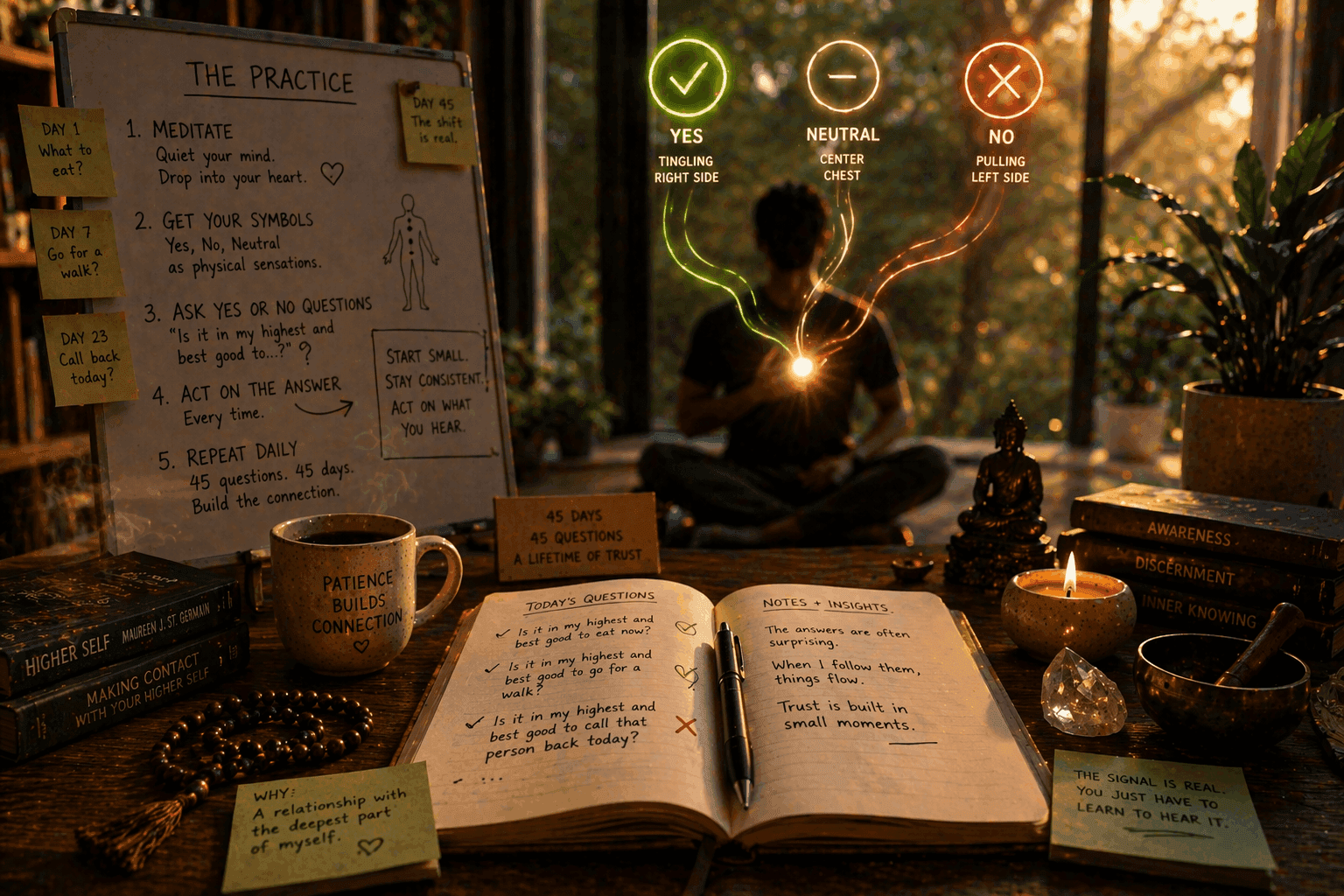
The practice I was taught by Maureen J. St. Germain begins with getting into a meditative state. Not a deep, hour-long session — just a few minutes of quiet. Eyes closed. A few slow breaths. Dropping your awareness from your head down into your heart. I find it helps to bring to mind something genuinely loving — a person, a place, a moment — and let that feeling expand before I begin.
From there, you ask your Higher Self to show you your symbols. One for yes. One for no. One for neutral.
Your symbols are physical sensations. Not thoughts. Not images, necessarily — though for some people they are. A tingling. A warmth. A subtle pressure. A shift in energy. Something your body produces that is distinct and consistent and does not require interpretation.
This is the part people often struggle with at first. I struggled with it too. I sat in meditation waiting for a clear signal and felt almost nothing.
If that happens to you, there is a workaround. Rather than waiting for symbols to arise naturally, you assign them deliberately. You focus on the right side of your body — your arm, your chest, your leg — and wait until you feel any sensation at all. Then you say, inwardly: Higher Self, this is my symbol for yes. You disconnect from that feeling, return to neutral, and repeat the process on your left side for no. Then the centre of your chest for neutral.
It feels mechanical at first. It is supposed to. You are building a communication channel from scratch, and that takes repetition before it becomes fluid.
The 45-day practice
Once you have your symbols — whether they arose naturally or you assigned them — you begin asking yes or no questions. Every day. As many as you can manage, with a target of around 45 per day.
The questions stay deliberately small. Is it in my highest and best good to eat now? Is it in my highest and best good to go for a walk? Is it in my highest and best good to call that person back today?
There is a specific reason for the phrasing. You are not asking what your Higher Self prefers in the abstract. You are asking what is in your highest and best good — meaning what serves your growth, your alignment, your truest path — right now, in this moment, given everything your Higher Self can see that your conscious mind cannot.
That distinction matters. And saying it consistently trains both you and the connection.
The other rule is this: only ask questions you are willing to act on. If the answer is yes, you follow through. Every time. No matter how small the decision.
This is the part that separates people who build a real connection from people who dabble. Acting on the guidance — especially when it surprises you, especially when it is inconvenient — is what tells your system that you are serious. It is what builds the trust in both directions.
What happens as the days pass
In the early days, the signals may feel faint or inconsistent. That is normal. You are not doing it wrong. You are simply early in the process of learning a new language.
Around the two-week mark, something usually begins to clarify. The sensations become more distinct. The difference between yes and no becomes easier to feel. You start to notice that the answers are often surprising — that your Higher Self is not simply confirming what you already wanted — and that when you follow those surprising answers anyway, things tend to go better than they would have if you had overridden them.
By day 45, the research your ego needed has largely been compiled. The resistance softens. The logic of the practice has proven itself through experience rather than argument.
That is the only way this works. Not through belief. Not through intellectual acceptance. Through doing it, tracking what happens, and letting the results speak.
A note on patience
My own symbols took over a year to feel truly reliable. Another year before I could say with complete confidence that I fully trusted them. That is not a discouragement — it is an honest account of what building something real actually requires.
There are no shortcuts here. Your why has to be stronger than your excuses. But the reward on the other side of that patience is not just a useful practice. It is a relationship — with the deepest, most reliable part of yourself — that you will draw on for the rest of your life.
Start small. Stay consistent. Act on what you hear.
That is how the connection is built.
In the next blog, I'll share what the 45-day practice actually looked like in my own life — and the moment I knew something real had shifted.
Written by
Abhinayan M. Kugendnan
Other Artilces