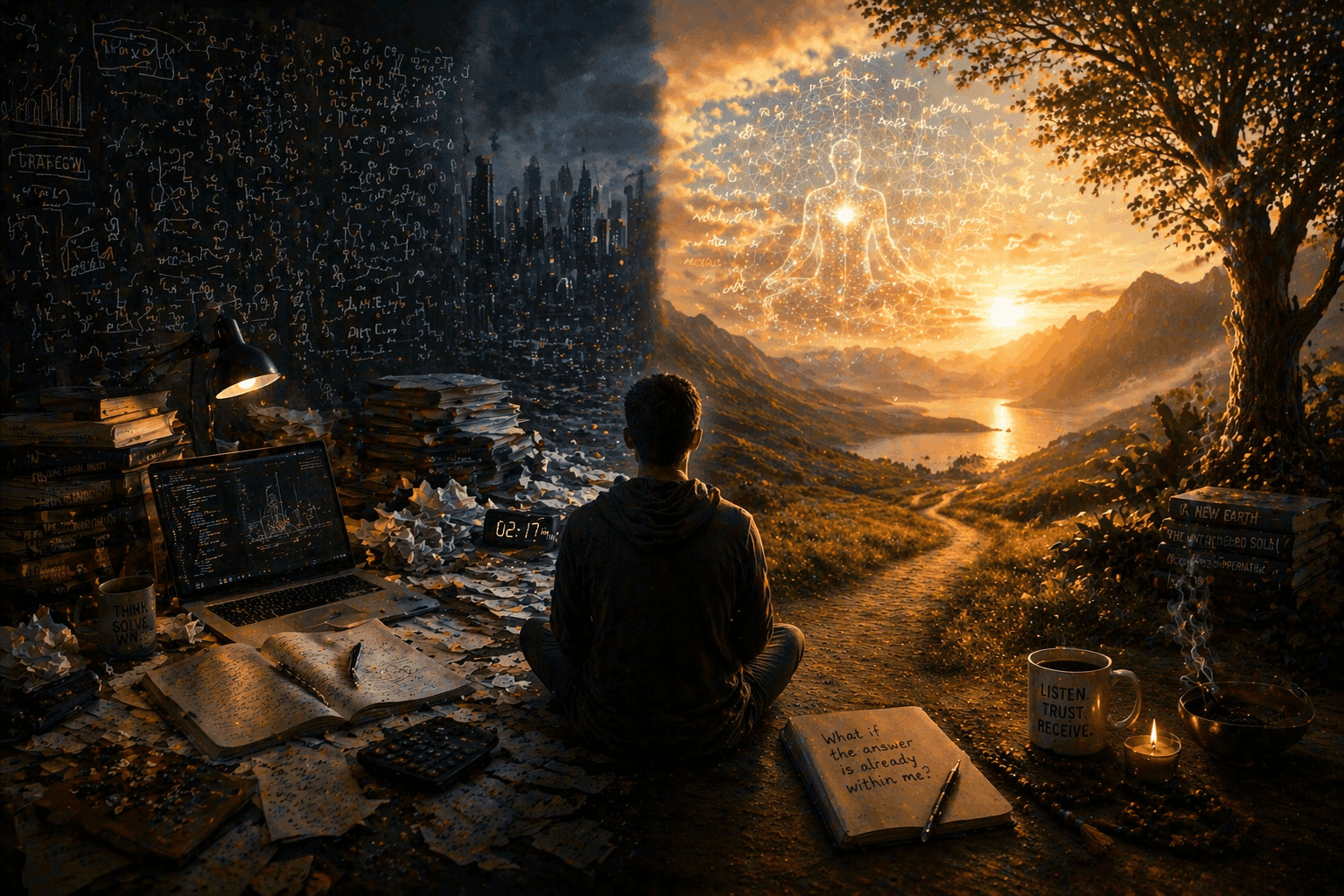
I Thought Intelligence Was the Ultimate Superpower — Here Is What I Found Instead
Someone once asked me what superpower I would choose if I could have any.
Without hesitation, I said: superintelligence.
Not flight. Not invisibility. Not strength or speed or any of the things people usually say. Intelligence. The ability to figure out any problem, outmanoeuvre any obstacle, design any outcome I wanted. I saw it as the ultimate edge — the one thing that, if I had it fully, would give me complete control over my life.
That belief sat at the centre of everything I did for years. And it took a very long time — and a very humbling set of experiences — for me to understand how fundamentally wrong it was.
The operating system I inherited
I grew up in a household shaped by engineering. My father was an engineer. Precise, logical, methodical. The mind, in our world, was the instrument through which life was mastered. You thought clearly, you planned carefully, you executed — and results followed.
I inherited that framework completely. I thought like an engineer: if I could just sharpen my thinking, discipline my habits, and outwork the noise around me, I could get everything I wanted. Success, satisfaction, peace. The good life.
The mind was the master. Everything else was downstream of it.
And for a while, that framework served me. It got me through school, into university, into a corporate career. It gave me a way of moving through the world that felt purposeful and directed.
What it could not give me was peace. Or connection. Or any real sense that the life I was building actually meant something.
The moment I decided to sharpen the instrument
I came to meditation through the mind, not the heart.
I was not searching for enlightenment or spiritual awakening or anything that might have sounded vague or unserious to the version of me I was then. I wanted focus. Clarity. An edge. Meditation, I had read, improved cognitive performance. It reduced stress. It made high performers perform better.
So I started. Five minute sessions in a quiet room at my corporate office. I would sneak away during the day, set a timer, sit cross-legged on the floor, and close my eyes.
And my mind would immediately explode.
Deadlines, worries, memories, chores, emails — everything crashed in at once the moment I stopped moving. Stillness felt not just difficult but almost physically impossible. The noise inside was so loud and so relentless that sitting in silence felt like standing in the middle of a storm.
I kept going anyway. Day after day. The silence never came.
I tried Wim Hof's breathing method. That stirred something — tingling, clearing, a kind of internal movement I had not felt before. It helped me reduce some of my drug use. But it was not enough. I was still stuck. Still spinning. Still trying to solve from the inside of the problem.
The retreat that cracked everything open
A friend mentioned Vipassana. Ten days of silence, ten hours of meditation a day, no phones, no books, no talking, no distractions of any kind.
I laughed when I first heard it. Ten days of silence — who would ever do that?
But I was backed into a corner. I had quit my corporate job. A business venture had collapsed. I had no plan and no direction and a quiet desperation I had run out of ways to manage. I needed something I could not think my way to.
So I signed up.
What happened over those ten days did not sharpen my mind. It showed me something the mind could not show itself.
The first few days were dominated by noise — the same thoughts looping endlessly, memories surfacing without invitation, the full chaos of an inner world that had never been asked to be still. I sat with physical pain as my joints refused to cooperate. I sat with irritation at the smallest things. I sat with the longing to turn to someone next to me and ask: is this happening to you too?
But as the days passed, something began to shift.
I noticed that when I stopped fighting the thoughts — when I simply watched them without engaging — they eventually dissolved. More would rise. Those too would pass. The storm was real. But it was not permanent. And beneath it, there was something else. Something quiet. Something that had nothing to do with effort or intelligence or figuring anything out.
There were moments of real physical agony in those sessions. And then — without my body changing — the pain would simply disappear. What had shifted was not anything physical. It was my relationship to the experience. And that realisation landed in me with a force that no intellectual understanding ever had.
The mind was not the master. It never had been. It was a tool — a powerful one — but it was meant to serve something deeper, not to lead it.
What that deeper thing turned out to be
After Vipassana, I kept searching. The experience had cracked something open and I could not close it. I found my way to a practice of connecting with the Higher Self — a concept I initially resisted because it sounded vague and unverifiable to the engineer in me.
But I could not deny what I felt when I began the practice. Something clicked. Something opened. And over two years of dedicated effort, I built a connection to an aspect of myself that was quieter than the mind, slower than thought, and consistently more accurate than anything my intelligence alone had ever produced.
My Higher Self did not think. It knew. And the difference between thinking and knowing — between the mind generating an answer and something deeper simply having it — was something I had to experience directly to understand. It cannot be transferred through explanation. It can only be lived.
What I found on the other side of the belief in intelligence as the ultimate superpower was not less capability — it was a different kind of capability entirely. A way of navigating that did not require me to figure everything out. A compass that did not run on logic but on something I still do not have complete language for — only direct experience of.
What I know now
The mind is extraordinary. I do not want to suggest otherwise. The capacity to think clearly, to reason, to see patterns and solve problems — these are real gifts and I use them every day.
But the mind is not designed to be the master. It is designed to serve. To take the direction that comes from something deeper — from the soul, from the Higher Self, from whatever you want to call the part of you that is not shaped by fear or conditioning or the need to be right — and to execute it with skill and precision.
When the mind tries to be the master, it inevitably defaults to what it already knows. It optimises for familiar outcomes. It avoids the unfamiliar even when the unfamiliar is exactly what is needed. It mistakes certainty for truth and confidence for wisdom.
The life I was trying to build by mastering my mind was a life built entirely from the inside of what I already knew. And what I already knew was not enough. It could not take me where I actually needed to go.
What could — what eventually did — was learning to listen to something the mind cannot generate on its own.
That is not a mystical statement. It is simply an honest account of what I found when I finally stopped trying to think my way to everything.
The superpower I was looking for was not superintelligence.
It was the willingness to become quiet enough to hear what was already there.
What that connection actually feels like is something I describe in full here.
Written by
Abhinayan M. Kugendnan
Other Artilces