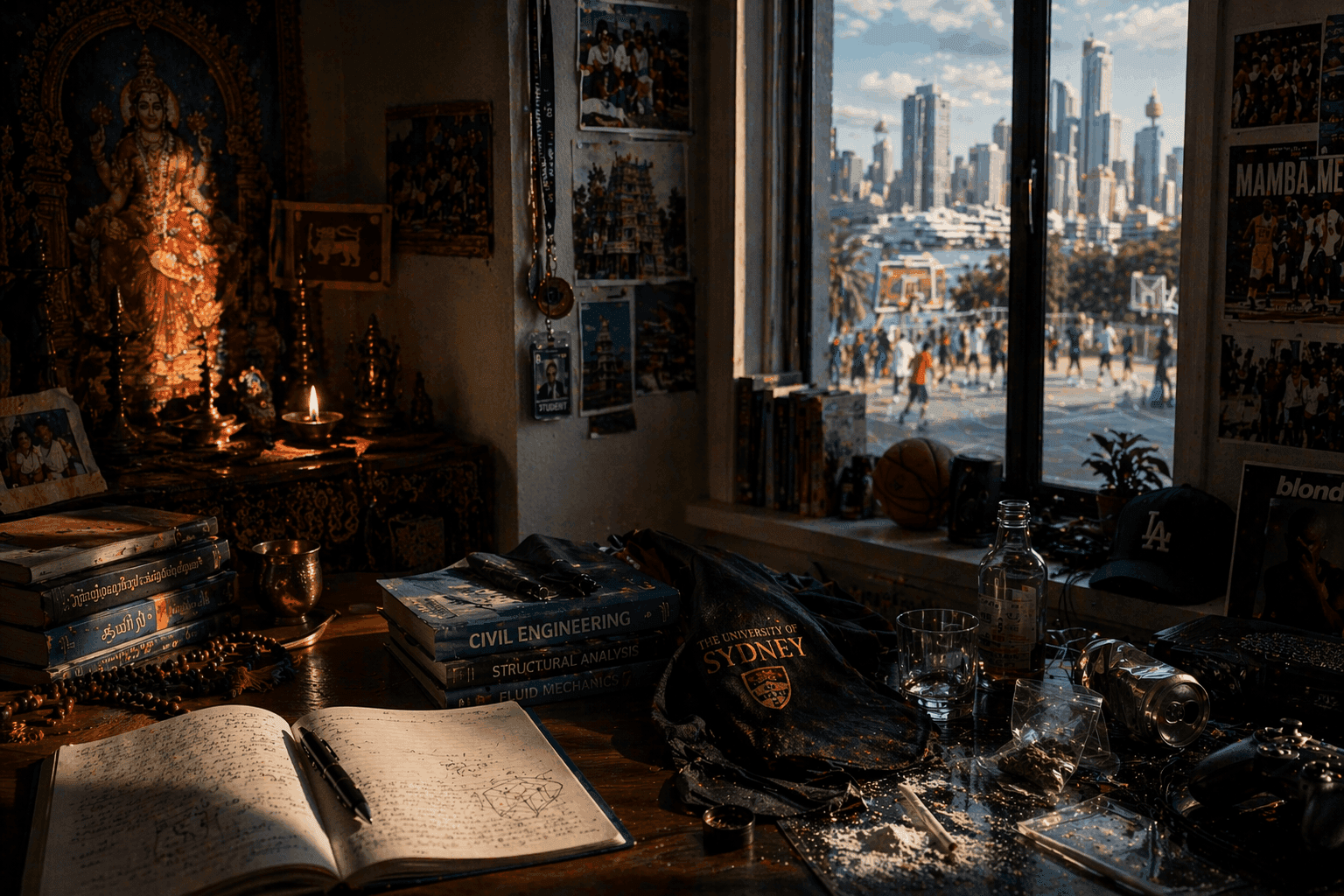
The Identity I Built to Survive Two Worlds That Never Quite Fit
I was six months old when my parents left Sri Lanka.
They came to Australia with everything they carried — their language, their rituals, their cultural expectations, their way of understanding what a good life looked like and what a good son was supposed to become. They built a home in a Western world that was nothing like the one they had left. And I grew up inside that home — Tamil at the dinner table, English at school, Sri Lankan at the temple, Australian everywhere else.
Two worlds. Two sets of rules. Two versions of what was expected.
And nowhere, in either of them, did I fully belong.
The split that happened without my knowing
I did not consciously decide to become two different people. It happened the way most survival strategies happen — gradually, quietly, and without anyone pointing it out.
At home, I was the obedient son. I played the role. I sat through the rituals I did not understand. I spoke Tamil when I was supposed to and nodded at cultural expectations that felt foreign to me even though they were, technically, mine. I was performing a version of myself that my parents needed to see — and I was doing it well enough that no one ever questioned it.
At school, I was someone else entirely. The outsider who had learned to mask the outsider-ness. I became the kid who knew how to read the room — who to align with, what to say, how to perform coolness in a world that was still fundamentally not mine. I skipped school. I drank. I got into recreational drugs. Not because I loved any of it. But because fitting in had a currency, and I had figured out how to pay it.
I learned early that belonging had a price. And I paid it — with pieces of myself I did not even realise I was losing.
What I was actually searching for
Looking back now, I can see something I had no language for at the time.
What I was searching for underneath all of it — underneath the performance and the substances and the constant shape-shifting between worlds — was not popularity or acceptance or even love in any conventional sense.
I was searching for wholeness.
For a version of myself that did not have to split depending on who was in the room. For a place — inside myself or somewhere in the world — where I could simply be one person. Consistent. Honest. Fully present.
I had never experienced that. And the ache of not having it was something I carried everywhere, even when I could not name it.
The choices I made from fear
Academically I was sharp. I could see patterns, cut corners, and coast on competence without ever fully investing. I relied on intuition more than I realised — reading energy, scanning ahead, figuring out what each situation required before anyone else had caught up.
But my choices were made in fear, not freedom.
I picked civil engineering because it made sense. My father was an engineer. I was good with systems. It was a path I could explain and justify — to my parents, to my culture, to the part of me that needed to have a reason that other people would approve of.
I passed on the subjects I actually loved. There was a design and technology class where we built things by hand. I loved the smell of sawdust, the feel of wood, the satisfaction of making something real with my hands. But I told myself it was not smart. It would not scale. It would not pay. It did not fit the blueprint of the life I was supposed to be building.
That became one of my earliest and most instructive regrets. Not because engineering was the wrong career — but because the decision was made from someone else's values, not mine. It was the first clear moment I can point to where I chose the version of my life that would be understood and approved of, over the version that was actually mine.
Living for logic over joy is a quiet betrayal of the soul. That is a lesson I also explore through the lens of career. I did not understand that then. I understand it now.
The identity that took over
By university, the persona had solidified. I was getting high every day. Weed was constant. Cocaine and ecstasy on weekends. Psychedelics when I could find them. I cycled through addictions, telling myself I would stop — and never really stopping.
I did not want any of it. But I could not seem to climb out.
The culture was seductive. The escape was easy. And the deeper truth — which I could not have articulated at the time — was that the substances were doing something the rest of my life was not. They were giving me a momentary break from the performance. A few hours where I did not have to be the good Sri Lankan son or the cool Australian kid or the driven engineering student or any of the other roles I was exhausted from playing.
They were, in their own broken way, the closest thing I had to relief.
Underneath all of it, something was accumulating. Shame about who I was becoming. Guilt about the gap between my private life and the version I was showing my family. A quiet disgust that I had so much drive and ambition and yet could not seem to stop destroying the very thing I was trying to build.
I was a divided person. And division, sustained long enough, becomes its own kind of damage.
The healing that eventually came
The fracture in my identity did not heal all at once. It happened in layers, over years, and it required me to go back to the place I had spent so long rejecting.
Returning to Sri Lanka — spending three years there in my late twenties — was the beginning of a reconciliation I had not known I needed. I had spent my entire life treating my Sri Lankan heritage as a burden, as something foreign and inconvenient that had been imposed on me. I had quietly disowned it, and in doing so had disowned a part of myself I did not even know was missing.
Being in Sri Lanka began to reverse that.
I started speaking Tamil again — not as an obligation but as a natural part of daily life. I shared meals. I moved at the rhythm of the land. I built real friendships with people from a world I had kept at arm's length. And slowly, something that had been tight and defended in me for as long as I could remember began to soften.
What emerged was not a sudden sense of cultural pride or a romanticised reconnection with my roots. It was quieter and more fundamental than that. It was the beginning of becoming one person.
Not a Sri Lankan person or an Australian person. Just a person. With one life, one set of values, one authentic way of moving through the world.
That was what I had been searching for since I was a kid navigating two planets that never quite overlapped.
What I know now
The identity I built to survive two worlds served a purpose. It kept me functioning. It kept me belonging, in a surface-level way, to both the worlds I moved between. Without it, I am not sure I would have made it through.
But it also cost me enormously. Years of not knowing who I was. Decisions made from other people's blueprints. Relationships that never got the full version of me because I was not sure myself what the full version looked like.
The work of becoming whole — of dissolving the split that started in childhood and ran through every major decision I made as a young adult — has been the most important work of my life. More important than any achievement, any career move, any external marker of success or progress.
Because everything else you build — every relationship, every vision, every attempt at a meaningful life — is only as solid as the foundation of knowing who you actually are.
That foundation was missing for me for a long time. And finding it — or rather, building it slowly, painfully, honestly, over years — is what this entire journey has been about.
You cannot belong to the world until you belong to yourself first. The version of this story as it played out in daily life fills in the gaps.
That is the thing nobody tells you when you are a kid navigating two worlds that never quite fit.
It is the most important thing I know.
Written by
Abhinayan M. Kugendnan
Other Artilces