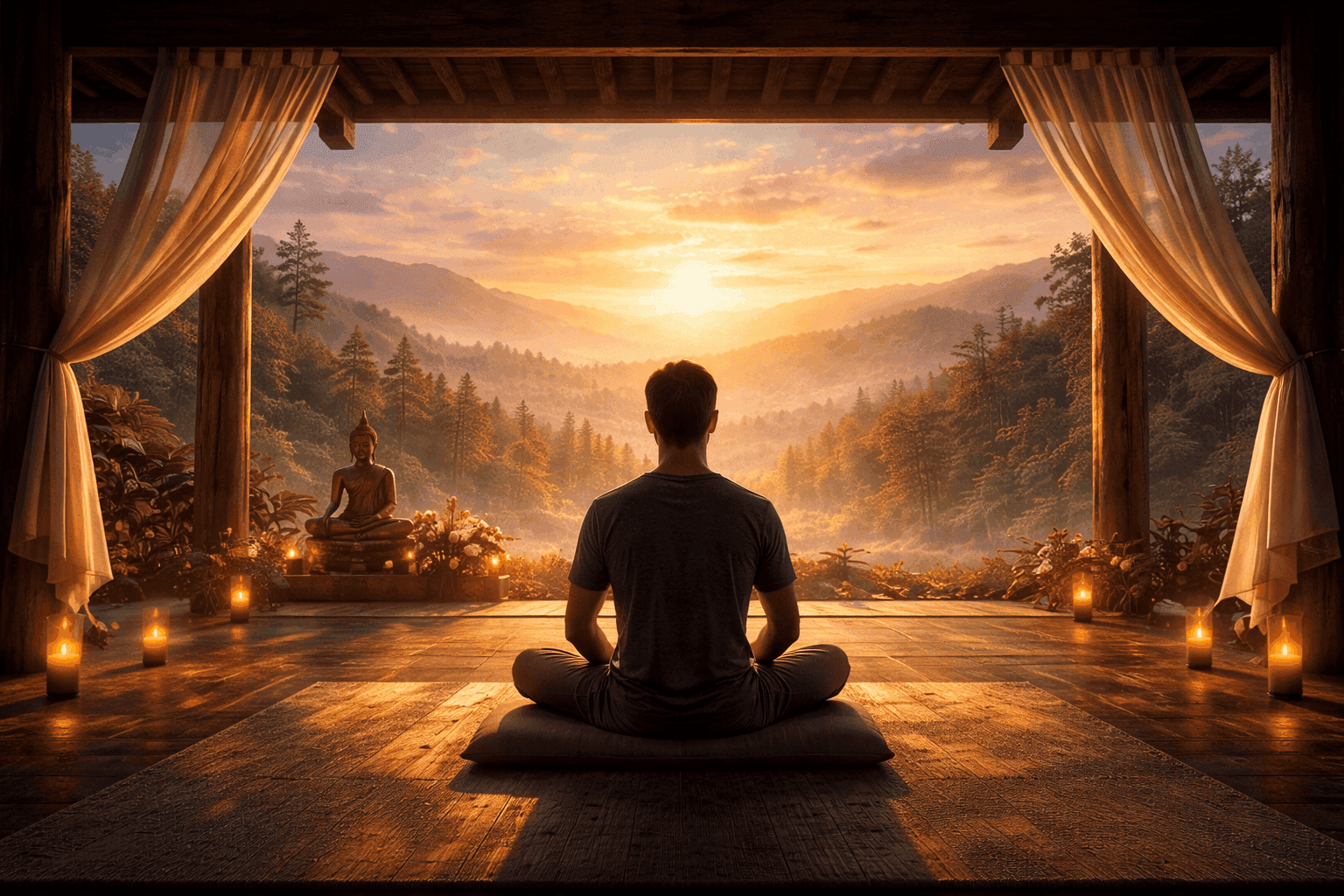
The Ten Days That Changed How I Relate to Everything
The Ten Days That Changed How I Relate to Everything
I laughed when I first heard about it.
Ten days of silence. No phone, no books, no talking, no eye contact. Ten hours of meditation a day. Just you and your mind and whatever comes up between them.
"Who would ever do that?" I said.
Then life backed me into a corner. I had quit my corporate job. A business venture with my sister had collapsed. I had no plan, no direction, and a quiet desperation I had run out of ways to numb. I needed something radical. Something I couldn't talk my way around or optimise my way through.
So I signed up for Vipassana. And it changed how I relate to everything.
What I thought I was signing up for
I came to meditation through the mind, not the heart. I wasn't searching for enlightenment or spiritual connection. I wanted control. Focus. An edge.
Someone once asked me what superpower I would choose if I could have any. Without hesitation I said superintelligence. I believed intelligence was the ultimate advantage — the ability to figure anything out, solve any problem, design any outcome. That belief sat at the centre of my life.
So meditation, to me, was a tool. A way to sharpen the instrument. I started with five minute sessions in quiet rooms at my corporate office. I would sit down, close my eyes, and my mind would immediately explode — work tasks, deadlines, memories, worries, everything crashing in at once. Stillness felt impossible. But I kept going, day after day, and the silence never came.
Vipassana felt like the next logical step. A more intensive version of what I had been trying to do.
What I did not anticipate was that it would not sharpen me. It would strip me.
The first few days
The pain hit fast.
My joints were not flexible enough to sit for long periods. After ten minutes I needed to shift. The instruction was to stay still, to observe sensation without reacting to it. That instruction felt almost cruel.
But I had reached a point where running was no longer an option. Something in me had decided: I am going to face this. Whatever comes up, I am going to sit with it.
What I did not realise was that I wasn't just facing physical discomfort. I was meeting the entire architecture of my inner world.
The silence was unlike anything I had experienced. I was surrounded by other people, all sitting in the same room, all going through their own version of the same thing — and I was completely alone. Thoughts surged through me. Memories I had not visited in years. Emotions with no clear source. I longed to turn to the person next to me and ask: are you going through this too? But I couldn't. That was the point.
Even the smallest irritations became amplified. My mouth would flood with saliva during sessions — constant, distracting, impossible to ignore. And like everything else, I had to let it be.
What the silence showed me
Within a few days, I started to notice something.
My mind was looping. The same thoughts, the same images, the same internal loops — cycling through again and again. But when I stopped resisting them, when I simply watched them without engaging, they began to dissolve. And then new ones would rise. And those, too, would pass.
That was the first real insight: the mind is a storm. But storms pass. Stillness is always underneath, waiting. You do not have to chase it — you just have to stop running from everything else.
Then pain became the teacher in a different way.
There were moments of real physical agony sitting on that cushion. And then — without my body changing at all — the pain would vanish. Just disappear. What had shifted was not my body. It was my relationship to the experience.
That rattled me. Because if the mind could release pain that deeply — pain I had been certain was physical — what else was it capable of? What else was it creating?
The insight that stayed with me
The deepest thing I took out of those ten days was not a technique or a framework. It was a direct experience of something I had only ever read about.
Truth cannot be transferred.
You can read about meditation. You can listen to teachers, watch videos, understand the theory perfectly. None of it compares to sitting in silence and meeting yourself. Wisdom becomes real only through direct experience. Not through information. Not through understanding. Through presence.
I had spent years trying to master my life through my mind — through information, logic, strategy, and control. Vipassana showed me something I could not think my way to: that the mind is not the master. It never was. It is a tool. A powerful one. But it is meant to serve something deeper.
By day ten, something had settled in me that I had never felt before. A quiet. A spaciousness. Not the absence of thought — but a presence beneath it. Peace, in a form I had no previous reference point for.
And then came the question that would shape the next phase of my life: how do I hold on to this? How do I grow this?
What changed after I left
The practical changes were immediate. I went from someone who could barely sit still for thirty minutes to someone who could meditate for hours. Not because I had mastered anything — but because I had learned to stop fighting what arose, and simply watch it.
But the deeper change was in how I related to difficulty.
Before Vipassana, discomfort was something to escape. Pain was a problem to solve. Silence was a void to fill. After ten days, all of that began to shift. Discomfort became information. Pain became a messenger. Silence became the place where the most important things could finally be heard.
That shift did not just change my meditation practice. It changed how I moved through the world. How I handled conflict, uncertainty, and loss. How I sat with things I could not fix. How I learned, slowly, to stop reaching for the next distraction and start trusting what the stillness was trying to show me.
I did not come out of that retreat enlightened. I came out quieter. More honest. Less certain about most things — and more certain about one: that the answers I had been searching for were not out there. They had always been in here. I just needed to be still enough to hear them.
That retreat did not give me peace. It showed me where peace already lived.
And everything changed from there.
Insights you may find helpful.
Search for specific blogs


About
Our Story
Team
Careers
Resources
Blog
Docs
Help
Product
Features
Pricing
Integrations
Contact
Support